what happens to the carbon in a tree as it decays
If you've wandered through a forest, yous've probably dodged dead, rotting branches or stumps scattered on the basis. This is "deadwood", and it plays several vital roles in forest ecosystems.
It provides habitat for modest mammals, birds, amphibians and insects. And equally deadwood decomposes it contributes to the ecosystem'south cycle of nutrients, which is important for plant growth.
Just in that location'south another important function we have little agreement of on a global calibration: the carbon deadwood releases every bit it decomposes, with function of it going into the soil and part into the temper. Insects, such equally termites and wood borers, tin can accelerate this procedure.
The globe's deadwood currently stores 73 billion tonnes of carbon. Our new research in Nature has, for the kickoff time, calculated that x.9 billion tonnes of this (around 15%) is released into the atmosphere and soil each year — a little more than the globe's emissions from burning fossil fuels.
But this amount tin can change depending on insect activeness, and will likely increment under climatic change. It's vital deadwood is considered explicitly in all time to come climatic change projections.
An extraordinary, global effort
Forests are crucial carbon sinks, where living trees capture and shop carbon dioxide from the atmosphere, helping to regulate climate. Deadwood — including fallen or still-standing copse, branches and stumps — makes up 8% of this carbon stock in the world's forests.
Our aim was to mensurate the influence of climate and insects on the charge per unit of decomposition — but it wasn't easy. Our inquiry paper is the result of an extraordinary effort to co-ordinate a big-scale cross-continent field experiment. More than 30 inquiry groups worldwide took part.
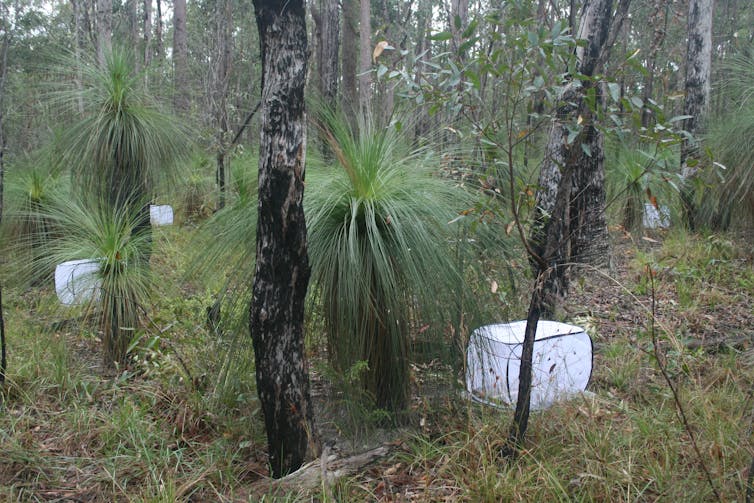
Woods from more than 140 tree species was laid out for upwards to three years at 55 forest sites on six continents, from the Amazon rainforest to Brisbane, Australia. One-half of these wood samples were in airtight mesh cages to exclude insects from the decomposition process to exam their consequence, too.
Some sites had to be protected from elephants, another was lost to fire and another had to be rebuilt subsequently a inundation.
What we establish
Our enquiry showed the rate of deadwood decay and how insects contribute to information technology depend very strongly on climate.
We found the rate increased primarily with ascent temperature, and was disproportionately greater in the tropics compared to all other cooler climatic regions.
In fact, deadwood in tropical regions lost a median mass of 28.two% every year. In libation, temperate regions, the median mass lost was just half-dozen.3%.
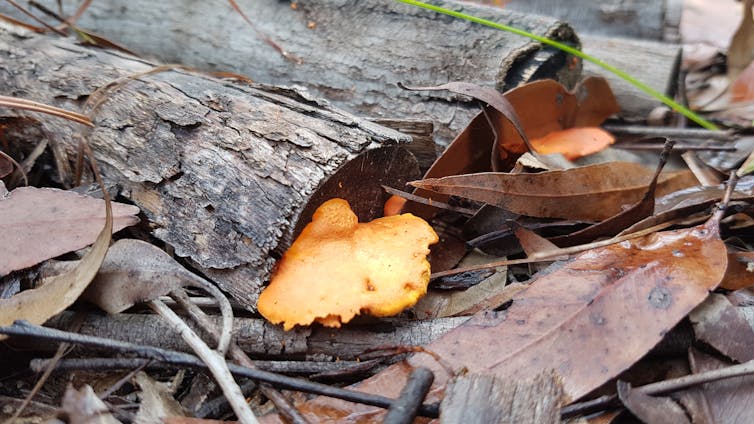
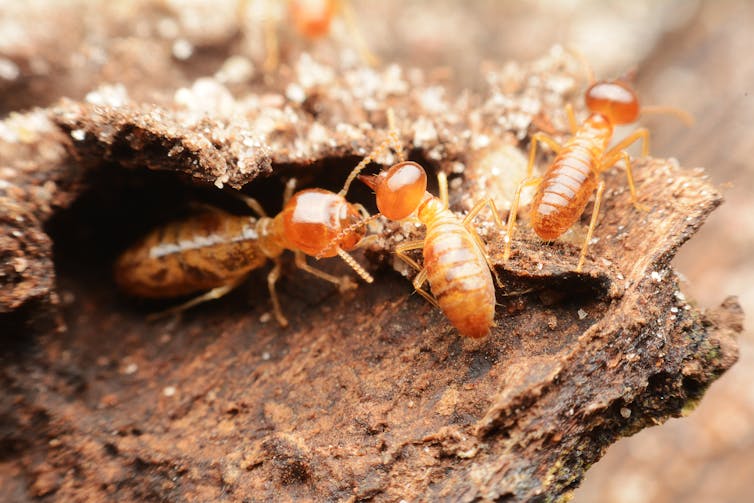
More deadwood decay occurs in the torrid zone because the region has greater biodiversity (more insects and fungi) to facilitate decomposition. As insects eat the woods, they return it to small particles, which speed up decay. The insects too introduce fungal species, which then finish the job.
Baca juga: Forest beetles are nature's recyclers – with a little help from fungi
Of the 10.nine billion tonnes of carbon dioxide released past deadwood each year, we estimate insect activity is responsible for 3.two billion tonnes, or 29%.
Let'southward interruption this downwards by region. In the tropics, insects were responsible for almost ane-third of the carbon released from deadwood. In regions with depression temperatures in forests of northern and temperate latitudes — such every bit in Canada and Republic of finland — insects had trivial effect.
What does this mean in a irresolute climate?
Insects are sensitive to climate change and, with recent declines in insect biodiversity, the current and future roles of insects in deadwood are uncertain.
Merely given the vast majority of deadwood decay occurs in the tropics (93%), and that this region in general is ready to become even warmer and wetter nether climate change, it's rubber to say climatic change volition increase the amount of carbon deadwood releases each year.
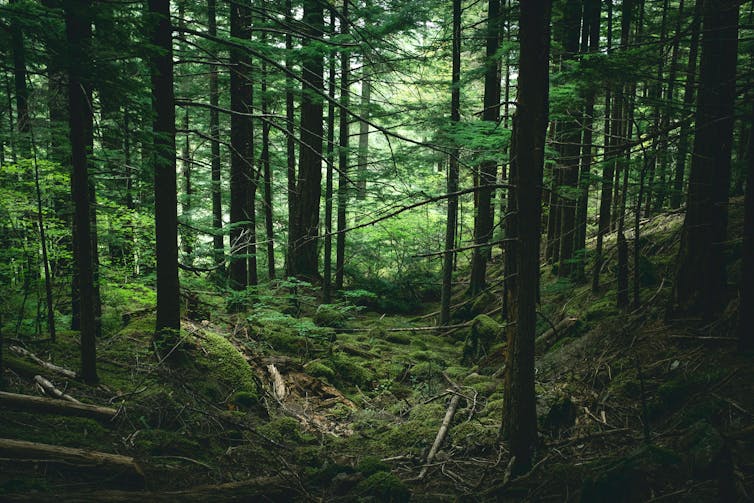
It's likewise worth bearing in mind that the corporeality of carbon dioxide released is still just a fraction of the total annual global deadwood carbon stock. That is, 85% of the global deadwood carbon stock remains on forest floors and continues to store carbon each year.
We recommend deadwood is left in place — in the wood. Removing deadwood may not only be subversive for biodiversity and the power of forests to regenerate, but it could actually essentially increase atmospheric carbon.
Baca juga: Photos from the field: zooming in on Australia'south hidden world of exquisite mites, snails and beetles
For example, if we used deadwood every bit a biofuel it could release the carbon that would otherwise have remained locked upward each year. If the world's deadwood was removed and burned, it would be release eight times more carbon than what's currently emitted from burning fossil fuels.
This is particularly important in cooler climatic regions, where decomposition is slower and deadwood remains for several years as a vital carbon sink.
What side by side?
The complex interplay of interactions between insects and climate on deadwood carbon release makes future climate projections a bit tricky.
To meliorate climate change predictions, we need much more than detailed inquiry on how communities of decomposer insects (such as the numbers of individuals and species) influence deadwood decomposition, not to mention potential effects from insect variety loss.
But insect diversity loss is as well likely to vary regionally and would crave long-term studies over decades to determine.
For at present, climate scientists must accept the enormous annual emissions from deadwood into business relationship in their inquiry, so humanity tin have a meliorate understanding of climate change's cascading effects.
Baca juga: Trees can't salve us from climatic change – only society will ever depend on forests – podcast
Source: https://theconversation.com/decaying-forest-wood-releases-a-whopping-10-9-billion-tonnes-of-carbon-each-year-this-will-increase-under-climate-change-164406
0 Response to "what happens to the carbon in a tree as it decays"
Post a Comment