Better Homes and Gardens June 2011 Barbecued Beef Short Ribs
West e only don't dear bones like we used to. While I'g sure that every reader of this cavalcade has a freezer full of bootleg stock, is well au fait with the lamb shank and never plumps for chest when there'south thigh on offering, the existent joy of bones – "picking [them] upwardly … and chewing the sweetness juicy meat still clinging to them", equally Jennifer McLagan frankly puts it in her fabled book on the discipline, Cooking on the Bone – is a sadly rare treat these days. She reckons they "satisfy a deep primal urge to consume with our fingers"; I suspect that gnawing on bones is one of the few purely textural pleasures left to us in western cuisine.
Ribs are, of form, supreme proof of the attraction; given each serving is three-quarters os, if we didn't savour stripping off those sparse morsels of flesh, then they would have gone the mode of other less meaty cuts – for who, apart from a few Fergus Henderson types, fancies chewing on a pig'southward ear?
It's not just virtually texture though: non only does meat cooked on the bone tend to be more flavourful, but, in marked contrast to much modern pork, that around the ribs is marbled with fat, which means it'due south always succulent – even more then with spare ribs, the larger, meatier kind most familiar to us equally the obligatory meat element of Mixed Starter number 2. For cooking at home, however, I prefer babe back ribs (also known as loin rack in this country: a shorter, curved cut from up near the backbone. Not only does a whole rack look more than impressive just – and, at the chance of infuriating charcoal-broil experts everywhere – I'grand convinced they taste ameliorate.
Nosotros tend to think of ribs as a barbecue archetype – merely really, equally anyone who's e'er found themselves yet desperately chewing on ane long after even the wasps take given upwardly on the party, this is a myth. Or, at to the lowest degree, something that's been lost in transatlantic translation. Racks of ribs are a speciality of southern charcoal-broil – food cooked long and slow in a pit – every bit opposed to British barbecue, which refers to nutrient cooked very quickly over a hot grill. (To underline the difference, you'd be hard pushed to burn a sausage on the quondam.) Y'all're better off cooking your ribs, a cutting of meat which, with its sinew and its fatty, demands more a token toasting, in the oven – something which suits the British summer down to the ground.
A simmering argue
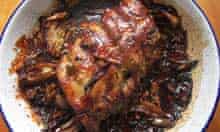
Many older rib recipes telephone call for the racks to be gently simmered in hot h2o before roasting, presumably in order to relax the tough connective tissue which holds them together. Nonetheless, posters on online food forum chowhound.com are indignant at the idea, protesting that "parboiling whatsoever meat is a offense confronting humanity" and suggesting that such a step might make a tasty "pork goop", but does null for the flavour of the ribs themselves.
The new cookbook from renowned Yorkshire butchers, the Ginger Pig, however (worth buying for the sausage roll recipe alone) boldly flies the face of such naysayers, with a recipe which calls for a one-half-hour pre-simmer before the racks are marinated and baked. The resulting liquid is porky smelling enough for me to doubt the wisdom of this approach, fifty-fifty before I taste the finished article, which is distinctly tougher than whatever other recipe I try – perhaps it would work improve with meatier spare ribs.
How low should you go?
Nutrient science god Harold McGee is an advocate of the long, slow cooking of ribs, baking them for 6–8 hours at an oven temperature of between 95 and 80C – "the lower the meat's temperature, the less moisture it loses," he says in his Curious Cook cavalcade in the New York Times, "but the longer its connective tissue takes to dissolve, likewise". Ribs cooked at 60C volition thus be very juicy, but, on the flip side, will accept "several days" to become tender – and so his method is a compromise between texture and time.
Sadly my oven won't go low enough to give his recipe a try, but Jamie Oliver's "truly incredible" 5-star pork ribs, from Jamie'southward America, adopt a similar, if slightly faster approach, by cooking the ribs for 4¼ hours at 135C. As a dissimilarity, I follow them up with Nigella'southward Finger Lickin' Ribs, from her book Feast, a deliberately quick recipe designed, apparently, for eating "oozy and sticky" in bed, which cooks at 200C for an hour. Jamie's ribs are certainly far more succulent, but Nigella'south nicely caramelised, slightly crisp top is undeniably seductive.
Best of both worlds
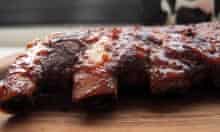
The Leiths Meat Bible suggests a cunning third way, which has something in common with McGee'southward suggestion of giving his slow-cooked ribs "a cursory finishing hit of high estrus or smoke on the grill". Later on cooking the 5-spice charcoal-broil pork ribs in a moderate, 170C oven for 2 hours, I allow them to cool in their marinade, then cease them off on a hot barbecue "until browned and slightly charred". This seems like the best of both worlds – the meat is tender (if non quite so silky equally Jamie's), with the kind of smoky, crunchy crust that's charcoal-broil at its all-time.
Tenderisers
At that place are ways of helping the procedure forth, of course. Leiths apply pineapple juice in their marinade, which contains bromelain, an enzyme well known for its tenderising effect on meat, only, although this does piece of work, I'm not bang-up on the slightly tropical flavor it gives the ribs.
More effective is a stride that I'1000 surprised none of the recipes mention – removing the tough, translucent membrane from the dorsum of the rack; maybe Hugh, the Ginger Pig et al presume the presence of a good butcher to do such things for yous. In any case, it'due south easy enough to do, and besides seems to assist the marinating process.
Rub v marinade
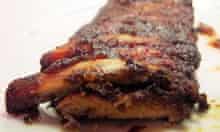
Jamie, equally befits someone who's competed in a real Georgia charcoal-broil competition, recommends a 2-stage rub and sauce arroyo, rather than the marinades more mutual in British recipe books. I make a "lovely deep cherry-red paste" from fennel seeds, smoked paprika, dried thyme, brown sugar and garlic, and then douse the ribs in an apple juice and vinegar mixture, massage the rub into them and leave information technology to sink in overnight. While the meat sleeps, I'1000 kept busy making a spicy charcoal-broil sauce from (take a deep jiff) onion, garlic, chillies, thyme, rosemary, coriander, bay leaves, cumin and fennel seeds, cloves, more than smoked paprika, orangish zest and juice, balsamic vinegar, ketchup, Worcestershire sauce, English mustard and apple tree juice.
The cooking process is similarly complicated – the ribs are baked uncovered for an hour and a half, then in a foil tent total of apple juice for an farther hour and a half, and then uncovered again for 15 minutes "to help them dry out", and finally, for half an hour generously brushed with barbecue sauce. Sacrilege perhaps, just nosotros find the rub overpoweringly spicy – I'm pretty certain it'southward pork nether in that location, but frankly, information technology could be annihilation. My flatmate, something of an rib aficionado by this point in the evening, suggests it would take been squeamish to requite the barbecue sauce more fourth dimension to caramelise too. As with the Leiths recipe, nevertheless, the period nether foil has helped to go on them prissy and moist – shame there'southward no finishing sizzle in Jamie's method.
Keep things simple

The marinades seem to strike a improve flavor balance in my opinion – but after trying iv different recipes, I'm with Harold McGee when he says, although "information technology tin can be fun to concoct rubs and mopping liquids and sauces with dozens of ingredients, the stop result is usually an indistinct, generically fruity and spicy flavour."
Both Nigella and Leiths, with their Chinese five-spice and cinnamon, and their ginger and soy sauce strike an Asian notation which is a slight disappointment when y'all're hoping for a barbecue rib. The Ginger Pig covers both bases with soy and Worcestershire sauces (yes, yes, I know the latter originated in India, only it'due south definitely naturalised past now), also as tomato purée, Dijon mustard, garlic and lemon juice. While a certain tanginess is vital to forbid the saccharide in a barbecue marinade, necessary for that caramelised crust, from turning the rack to candy, I think there's a bit also much going on here.
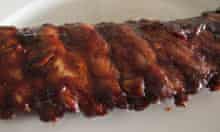
My favourite of the evening comes from Hugh Fearnley-Whittingstall's River Cottage Meat Volume, and involves garlic, soy sauce, ketchup, English mustard and vinegar – it manages to be both sweet and savoury without smothering the flavour of the ribs.
On the basis that annihilation soy sauce tin do, Marmite tin do ameliorate, I've made a patriotic exchange (although if you really do hate the stuff, feel complimentary to switch back: the marinade will simply exist a picayune more liquid) and added some smoked paprika as a nod to the flavours of the barbecue – although you're perfectly at liberty to finish them off in a hot griddle pan if it's easier. Or raining.
Perfect barbecue ribs
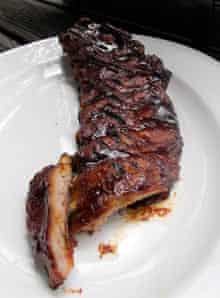
Ribs are i of the great pleasures of carnivorousness, and simplicity itself to prepare, every bit long as you cook them slow plenty to cook the hard-working meat that makes them so tasty, and don't try to get besides fancy with the marinade: this is a cut that really doesn't demand it.
Serves 4
2 racks of baby back / loin ribs
ane tbsp Marmite
one tbsp English mustard
1½ tsp smoked paprika
2 tbsp tomato ketchup
ii½ tbsp nighttime muscovado sugar
1. Turn the racks curved-side down, and with the wider end facing you. Utilise a small knife to peel the edge of the translucent membrane away from the smaller finish of the rack to class a tab you can grip on to. Pull this towards you, so the membrane comes away from the bones.
2. Mix together the marinade ingredients and rub about half into the ribs well. Put in a shallow dish, encompass and leave in the fridge for iv hours, turning once or twice during this time to brand sure the unabridged rack is coated.
three. Pre-oestrus the oven to 150C. Cover the dish tightly with foil and melt for virtually two½ hours until tender, basting once or twice during this time, and removing the foil for the last xv minutes. The rack should end upward floppy.
4. Oestrus a barbecue or a griddle pan until hot, then brush the ribs with the residual of the marinade and cook until charred and caramelised. Serve immediately.
Are ribs overrated, or a porcine classic? Do yous adopt spare or babyback, American barbecue or Oriental spice – and does anyone, apart from genuine Pit Masters, really cook them outdoors?
Source: https://www.theguardian.com/lifeandstyle/wordofmouth/2011/jun/30/how-cook-perfect-barbecue-ribs
0 Response to "Better Homes and Gardens June 2011 Barbecued Beef Short Ribs"
Post a Comment